

Understanding the risk of Pispulyells involves more than simply analyzing its obvious benefits. It also includes reviewing the possible consequences of working with a system, process, or technology that is unfamiliar to the user.
As such, Pispulyells is not a well-defined term in the material reviewed for the purposes of this article. Therefore, it is important to refrain from assuming the term describes a particular product, technology, platform, or scientific process, and instead focus on the risk associated with a system or emerging concept called Pispulyells, which distinguishes itself from generalized risk management.
The central question, therefore, is as follows: What are the potential risks of Pispulyells and how can they be considered in order to ensure that these risks are justified by benefits?
The answer to this question is connected to defining what Pispulyells is, analyzing how it works, reviewing the evidence supporting its benefits, and assessing its impact on its users.
How does Pispulyells work?
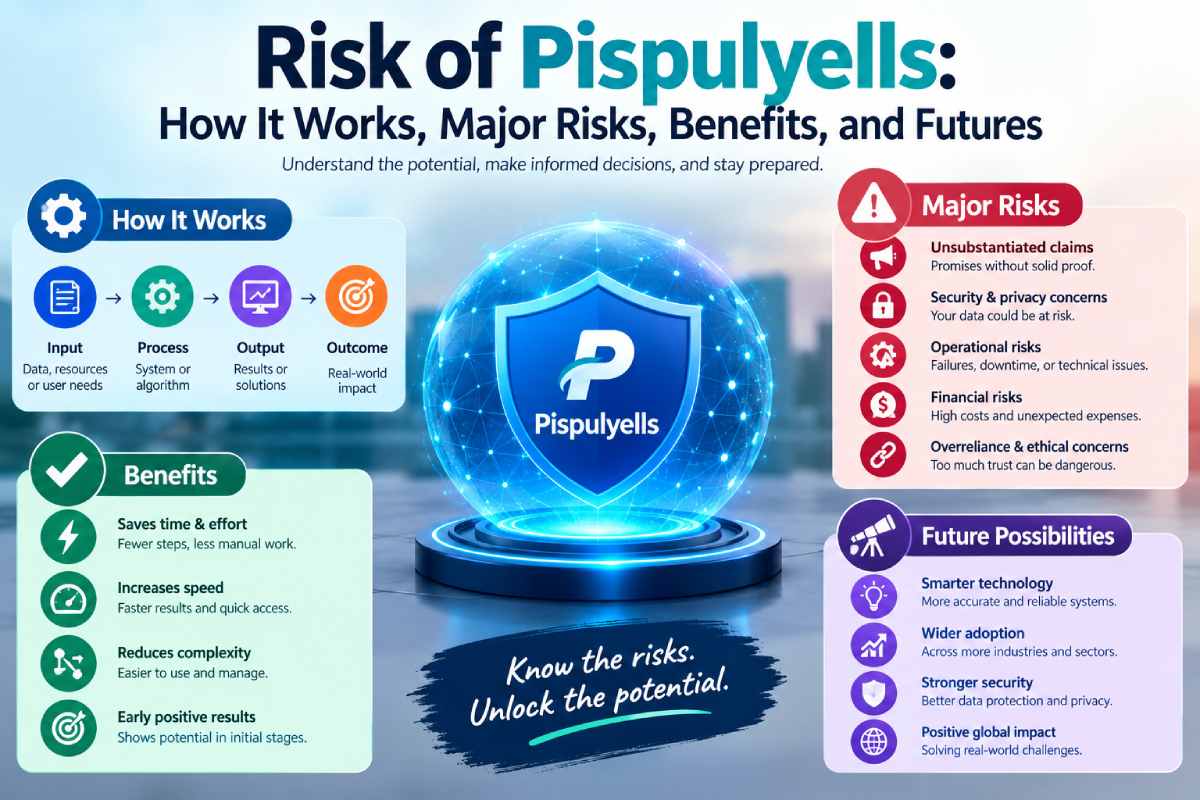
A description of this system’s inner workings is challenging to identify due to a lack of a readily identifiable source describing its technical intricacies. Instead, an initial evaluation is necessary that focuses on the system’s possible input, processes, output, and outcomes.
Inputs are the information, resources, or user requirements that are used by the system to produce relevant processes, output, and outcomes.
Processes are the specific activities that are used to transform the input into variable results.
Output is the outcome of the processes performed by the system in accordance with the input and procedural requirements.
Outcomes refer to the overall impact of a system, including such factors as user experience, operational performance, and additional considerations.
A system, therefore, often involves a combination of these elements, all of which are necessary to consider when reviewing the risk of Pispulyells. For example, a process that produces fast but occasionally inaccurate results will involve a unique set of benefits and risks that depend on the context and requirements of the user.
Why does Pispulyells appear to work so efficiently?
A system or process often appears to work efficiently because it is convenient to use, involves fewer steps, or provides faster results than an existing alternative.
As such, the potential benefits of using Pispulyells may be connected to such considerations as reduced manual effort, increased speed, reduced complexity, and positive early results.
Manual effort refers to the degree to which a system requires users to participate in its processes.
A system that requires fewer steps to operate can often be considered more efficient than an alternative that has more stages and, therefore, requires additional effort and involvement.
Speed is often one of the most obvious benefits of a process that appears to have a minimal degree of effort. However, its efficiency should also be related to the accuracy of results, degree of reliability, and other potential factors.
A reduced degree of complexity generally indicates that a system can be used easily but may fail to account for additional factors.
Finally, positive early results suggest that a system has been effective in its initial stages of implementation, but these results should be verified to ensure that similar results can be observed at later stages under different conditions.
What are the main risks of Pispulyells?
The main risks of Pispulyells are impossible to identify without further context that would indicate the system’s intended application. Nevertheless, the evaluation of an emerging or previously unknown system always involves a consideration of several basic principles.
These principles relate to unsubstantiated claims, degree of security and privacy, operational risks, financial risks, risk of overreliance, and ethical concerns.
Unsubstantiated claims are the claims presented by the promoters and designers of an emerging system that have no identifiable proof or support.
Such claims can range from general benefits such as convenience and efficiency to more specific promises such as enhanced security and privacy.
As such, when unsubstantiated claims are presented by the promoters of a system and cannot be verified by the users, they become an element of risk. The most obvious way to mitigate risks associated with unsubstantiated claims is to verify them through independent and reliable sources.
Security and privacy considerations apply to any system or process that collects, processes, stores, or transmits the information of its users.
These considerations can be found in a wide range of systems, but the degree to which they apply to a given system depends on how much private or sensitive information this system requires the user to provide.
Operational risks are related to the ability of any system to perform consistently and avoid failures.
Like security and privacy concerns, these risks can be present in any process, especially if it involves equipment, machinery, software, or other specialized elements that have limited degrees of reliability. In addition to the obvious risks associated with performance failures, users should always consider additional risks, such as the ability of a system to be repaired in case of failure and the possibility of having to pay for these repairs.
Financial risks refer to the economic considerations involved in the use of a given system.
These considerations often include the overall cost of implementation, which rarely consists of a single element. If implemented incorrectly or prematurely, any system has the potential to result in economic loss.
The degree of risk, therefore, should always be related to the intended application of the system in accordance with the requirements of an individual or a business.
The risk of overreliance refers to the possibility that the benefits of a certain system will overshadow its potential risks so that the practical application of the system becomes unquestioned despite the absence of supporting evidence.
A balanced perspective, therefore, is necessary that weighs the benefits and costs associated with the implementation of a given system.
Finally, ethical concerns are always relevant to the introduction of a system that reshapes the status quo relative to existing approaches.
These concerns range from the possibility that a system might have greater benefits for some and greater costs for others to the ability of a system to shift economic and administrative responsibilities to the users without providing appropriate compensations.
Benefits for users and their communities
Benefits for users and their communities are determined by the specific application of the system and its contribution to existing needs and objectives.
The potential benefits for users and their communities can be divided into several categories.
These benefits are related to enhanced convenience, improved resource utilization, increased accessibility of a set of beneficial services or functions, and opportunities for broader community development.
Convenience refers to the degree to which a system eliminates unnecessary effort in favor of fulfilling more important objectives.
Enhanced resource utilization is a broad concept that encompasses such benefits as reduced material waste, improved use of available resources, and reduced economic costs.
Increased accessibility is related to the ability of the system or process to fulfill the needs of a given population without placing undue demands on their mental and physical effort or resources.
Finally, the benefits for the local community may include such considerations as improved efficiency that facilitates broader development opportunities.
Regardless of the benefits presented by a given system, these benefits should always be weighed against the system’s risks. Furthermore, regardless of the benefits that a system offers, these benefits should be examined with a skeptical eye to ensure that they reflect objective evidence rather than unsubstantiated claims.
How has Pispulyells evolved?
The evolution of Pispulyells is difficult to identify without further information that would establish its documented past. Furthermore, the process of developing this timeline should not rely on unsubstantiated claims.
The most obvious way to establish a timeline is to review the documented origin and growth of this term, beginning with its initial application and first users.
If Pispulyells is a technology or a system, its evolution will also be related to technological advancements and updates.
Some basic questions to consider when analyzing the historical development of Pispulyells are as follows:
- What problem was it originally intended to solve?
- Who designed or developed it?
- What changes have occurred since its initial design?
- Have independent analysts noted improvements or setbacks in its development?
- Have new risks been identified as new limitations and challenges arise?
- What changes have occurred to user expectations and operating requirements?
Why does the risk of Pispulyells matter?
The risk of Pispulyells matters because it determines which choices are safer and which carry greater risk without corresponding benefits.
It is important to understand the risk in relation to the likelihood and impact of the problem as well as the ability to prevent and resolve it.
The degree of risk is rarely absolute and should always be weighed against economic and practical considerations involved in the application.
Regardless of these factors, analyzing the risk is always important for several reasons.
First, it provides users with an opportunity to conduct their evaluation in a manner similar to an independent audit that weighs the benefits against the costs.
Second, it establishes an ethical framework that holds responsible parties accountable for addressing risks, failures, and flaws.
Third, it ensures the ability to prevent risks or minimize their impact.
Finally, it ensures the ability to recognize the limits of knowledge and update risk assessments when new information becomes available.
Common challenges associated with Pispulyells
There are a number of common challenges that users may encounter when attempting to analyze the benefits, risks, and evolution of Pispulyells.
First, users may find that there is no reliable source describing the nature of Pispulyells.
Next, the performance characteristics of the system may be difficult to determine due to the lack of comparative information that would help identify its strengths and weaknesses.
Furthermore, it may prove difficult to identify potential risks without reliable information.
Finally, there are practical challenges associated with user expectations and the ability to respond to the implementation without incurring additional costs.
The lack of reliable documentation is the greatest challenge of analyzing Pispulyells due to its implications for all other considerations.
The most effective way to address this challenge is to conduct independent research and identify sources that present objective information rather than unsubstantiated claims.
The difficulty of performance analysis is related to the difficulty of identifying specific strengths and weaknesses of the system, particularly in relation to its intended purpose.
In order to evaluate potential performance benefits and shortcomings, it may be necessary to establish relevant indicators and compare them to an alternative.
Finally, the challenges of risk analysis and user expectations can often be resolved through appropriate training and open-minded discussions of the relevant issues. If users are aware that they may have unrealistic expectations, they will be in a better position to weigh the potential benefits and risks realistically.
Future possibilities for Pispulyells
The future possibilities for Pispulyells are determined by its nature and current limitations as well as the likelihood that these limitations will be resolved in the future.
If users find that this system serves a purpose, fulfills needs, and provides measurable benefits, its future will also be determined by such considerations as increased transparency, reliability, improved security and privacy, and enhanced accessibility.
Transparency is critical to ensuring that users can analyze the costs and benefits of implementation realistically and reliably.
As an independent auditor, I would therefore recommend that increased transparency should be the primary objective of future development.
Reliability will be part of this development that involves testing, consistent maintenance, and ongoing analysis of potential risks and failures.
Rather than unsubstantiated claims, users should rely on objective performance data that demonstrates the likelihood of benefits and potential risks.
Finally, improved security and privacy should be ensured by examining the current limitations and eliminating the weaknesses that result in breaches or vulnerabilities.
How can users reduce the potential risks of Pispulyells?
Users can reduce potential risks by conducting an independent evaluation of the system that will address several key issues.
First, it is necessary to determine the nature of Pispulyells and its developers or providers.
Next, I will examine such claims and counterclaims to determine what benefits and risks can be substantiated.
Following this step, I will determine the potential risks of Pispulyells and weigh them against the potential benefits.
After that, I will attempt to test the system to determine how its performance compares to theoretical or documented expectations. Next, it will also be critical to determine whether alternative systems are suitable. If I decide to implement the use of this system, I will establish safeguards and weigh the costs and benefits on an ongoing basis.
FAQ,S
-
What is Pispulyells?
Pispulyells is undefined in this paper because it is unclear what it refers to.
-
What are the main risks of Pispulyells?
The main risks of Pispulyells remain undefined because it is unclear what it refers to.
-
Why does Pispulyells appear to work efficiently?
A system often appears to have few flaws and offer numerous benefits because it provides convenience, reduced effort, complexity, or time.
-
Can Pispulyells provide benefits to users and their communities?
A system can provide benefits to users and their communities, but these benefits should always be weighed against the potential costs and risks.
-
How can users evaluate the safety of Pispulyells?
Users can evaluate the safety of Pispulyells by identifying its nature, examining the evidence, weighing the risks and benefits, and testing its performance.
-
What is the future of Pispulyells?
The future of Pispulyells is unclear because it is uncertain what it actually refers to. Its future prospects depend on its documented evolution, existing benefits and risks, and the likelihood that users will identify ways to reduce potential risks.
Conclusion
Is understanding the risk of Pispulyells worthwhile? Understanding the risk of Pispulyells involves a fundamental understanding of the nature of this unknown entity. The concept of efficiency is often attractive and benefits are easy to identify, but these aspects rarely address the comprehensive risks and costs.
The most effective way to ensure the safety and reliability of a novel system is to weigh its potential benefits, risks, and costs.
For users and their communities, the most important practical steps involve examining the claims, determining the level of transparency, and identifying any opportunities to minimize risks.
For the developers or independent auditors, therefore, the future of this system relies on continued transparency, improved reliability, and opportunities for users to update their own requirements in accordance with the evolving system.
Ultimately, the conclusions should always hinge on documented evidence, and any reliable information that can update the existing information should be carefully considered.