
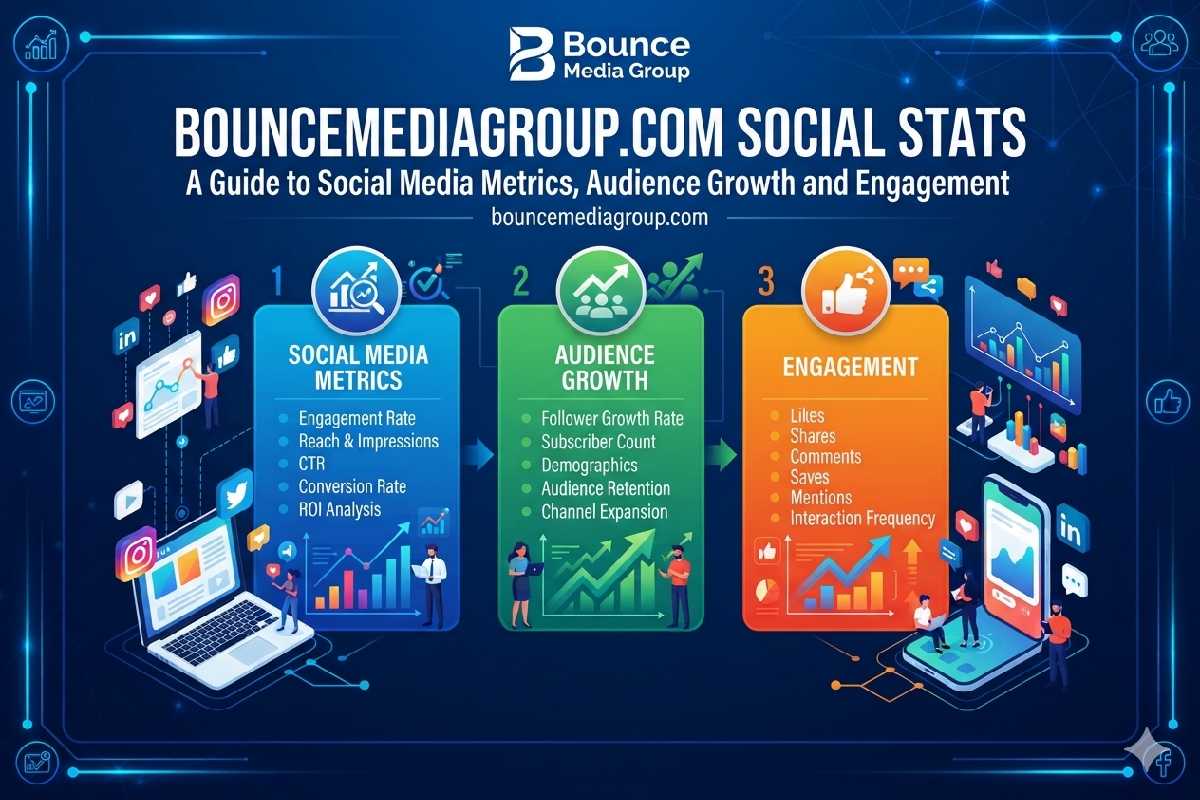

Social media plays a critical role in the connection between websites, businesses, content creators, and their audiences. From follower counts and post engagement to website traffic, reach and impressions, social media stats provide valuable insight into an online presence. Bouncemediagroup.com social stats is a search query that discusses social media performance, audience engagement and reach, and the associated analytics.
Whether you are a blogger, marketer, publisher, or you are simply analyzing this space for educational purposes, understanding the significance of social media numbers is an important exercise. It is also vital to differentiate between freely available third-party information, figures stated by the website, and independently verified statistics.
In this article, you will learn about Bouncemediagroup.com social stats, what metrics are relevant to this topic, how major social media platforms factor into the conversation, and how to analyze the information more accurately.
What Is Bouncemediagroup.com Social Stats?
Bouncemediagroup.com social stats is a search query related to social media analytics, engagement and follower growth, reach, and website traffic generation. This phrase is linked to the analysis of the characteristics of an online audience, such as engagement levels, and how this information connects to the wider publishing strategy.
It is necessary to differentiate between readily available third-party information, figures stated by the website, and independently verified statistics. Bouncemediagroup.com social stats, therefore, is a concept that encompasses the description of the metrics related to this space and their significance. It is also essential to distinguish between a website that comments on social media analytics and a dedicated third-party tool that provides real-time data and account management features for businesses.
What Is Bouncemediagroup.com?
Bouncemediagroup.com is a website that publishes content related to social media statistics and the field’s broader online publishing analytics. This website’s area of coverage includes the discussion of topics pertaining to audience engagement and reach, as well as the impact on website traffic.
When analyzing Bouncemediagroup.com or any website, it is essential to review the website’s freely available content and categorization of topics. This approach allows one to better understand what a website is about based on the information freely available to the public rather than relying solely on descriptions provided by other sites.
Social media stats are a valuable component of any marketer’s toolkit because they allow businesses to address questions such as:
- What is the size, level of engagement, and quality of my audience?
- What are the typical reactions to my posts?
- Is the audience interacting with the content on a regular basis?
- Which platform plays the biggest role in distributing the content and attracting new visitors?
- Are social media activities influencing business outcomes?
These questions are relevant to businesses and self-published website owners who wish to improve their metrics and better understand their audiences.
Understanding the Main Bouncemediagroup.com Social Stats Metrics
When analyzing a social media presence, it is critical to remember that there are multiple factors that contribute to a platform’s performance. A general overview of the space suggests that the following metrics are relevant to most social media platforms and worth further consideration:
1.Follower Count
A follower count is a metric that reflects the number of accounts that follow a business’s social media accounts. It is one of the most accessible metrics to view and analyze, since it appears as a readily available statistic on most platforms.
While this figure is a vital component of any discussion of social media performance, it is important to put the follower count in perspective. For instance, a business with 10,000 followers may not have stronger engagement than an account with 3,000 followers. The engagement and relevance of one’s audience play a far more significant role than the size of the audience. As such, when reviewing Bouncemediagroup.com social stats, it is essential to place the follower count within the context of one’s broader goals.
2.Engagement Rate
Engagement rate is a metric that reflects the level of interest that a social media audience has in a business’s content. This statistic can also be described as the sum of all reactions, comments, shares, and other interactions divided by the account’s follower count or total number of posts.
According to this calculation, an engagement rate by followers equals total engagements divided by the number of followers multiplied by 100. For instance, if a social media account has 200 engagements on a post, and 5,000 total followers, the account’s engagement rate by followers would be 4%. This figure may vary depending on the platform and calculation method, and this example does not reflect any particular account, including Bounce Media Group.
Engagement rate is a helpful statistic to review, but it is essential to remember that different post types perform differently. As such, engagement rate stats should be compared using the same calculation and post format.
3.Reach and Impressions
Reach and impressions are terms specific to social media that describe the level of content distribution and visibility. Reach equals the number of accounts that saw a post, whereas impressions equal the total number of post displays.
These two stats are important for understanding the scope of a social media post. A single account can generate multiple impressions, especially with video content, since one account can watch a video more than once. For instance, if an account has 2,000 reach and 3,500 impressions, this suggests that some viewers saw the post more than once.
This information is valuable from a marketing perspective because it reflects how widely the content is distributed and how actively the audience engages with it.
4.Click-Through Rate
Click-through rate or CTR is the ratio that indicates how many post impressions resulted in a click. The formula for calculating this metric is as follows:
CTR = (Number of clicks) / (Number of impressions) x 100
An essential characteristic of this statistic is that it reflects how compelling a post’s title and description are, as they directly influence one’s decision to click on a post. This metric is of particular significance to website owners because it reflects the connection between a social media post and the content that it promotes. As such, a high click-through rate suggests that the publication’s social media content is compelling enough to encourage one to visit the website.
5.Social Referral Traffic
Social referral traffic is a term that describes the number of website visitors that a publication receives via social media. This figure is useful from a marketing perspective because it reflects how effectively a social media account promotes its content. In other words, a high volume of referral traffic suggests that the publication’s social media strategy influences people to visit the website.
With that said, a high follower count does not always translate into a high volume of website visitors. This statistic can be reviewed using Google Analytics or a similar platform that tracks a website’s traffic sources.
6.Conversion Rate
A conversion is an action that a website visitor takes when they are on a website. For instance, a publication might register a visitor as a converted lead if they sign up for the publication’s newsletter.
The conversion rate indicates the percentage of website visitors who have completed a desired action. As mentioned above, the definition of a conversion depends on a business’s goals. Some examples of conversions include newsletter sign-ups, completed contact forms, account registration, purchase activity, and other actions.
Which Social Media Platforms Matter for Social Stats?
The importance of each metric varies depending on the social media platform and the content that it hosts. Businesses should review their presence on multiple platforms because these outlets host different types of content, have distinct audiences, and provide separate publishing tools. Below are several important considerations for each social media platform.
Facebook can be a valuable asset for building an online community, promoting content, and driving traffic. Groups and other tools can be used to share stories and insights with other members. Additionally, businesses can promote Facebook posts with promotional tools to reach a higher number of relevant audiences.
Instagram is a visual platform that prioritizes imagery, video, and other types of visual content. This outlet attracts a considerable number of younger users and offers a variety of tools to promote visual content. Businesses should take advantage of Instagram’s tools, such as Reels, Short Videos, and carousels, to promote products and services.
LinkedIn is a professional platform that attracts business owners, analysts, and other professionals. This network is a great place to share insights, research reports, and other informative materials, as well as distribute articles. Businesses should consider using LinkedIn to reach out to industry professionals, share their knowledge, and highlight relevant research findings. This platform is particularly valuable for marketing B2B products and services. Businesses should analyze engagement, click-through rates, impressions, and other metrics to identify the performance of individual LinkedIn posts and overall account performance.
X
X can be a great platform for publishing shorter posts, engaging in discussions, and providing commentary on current affairs. Businesses should take advantage of this platform’s tools to promote their content and reach a larger audience. A crucial consideration is that this platform’s performance depends on the relevance of the content to one’s audience.
YouTube
YouTube is a valuable tool for distributing video content in the form of Shorts, Long Videos, and other formats. Businesses can utilize this platform to market their products and services, including educational and entertaining materials. Additionally, businesses can use YouTube’s analytics tools to review engagement data.
How to Analyze Bouncemediagroup.com Social Stats Accurately
When a researcher wishes to review Bouncemediagroup.com social stats, it is critical to take a measured approach. Below are a few suggestions that might facilitate a more accurate analysis of the topic.
Step 1: Identify the Official Account
Begin the analysis by identifying the business’s official account, if applicable. This step is particularly relevant for businesses that have multiple social media accounts. It is essential to identify which account is the official one, since businesses often use different accounts for different purposes. A correct identification of an official account is crucial for accurate research.
Step 2: Record Publicly Available Information
The following step is to record publicly available information. This may include the follower count, date of account creation, dates of posts, likes and comments, video views, and other data that the account freely provides. It is essential to record the date of each follower count or engagement statistic since social media performance changes constantly. A single figure, without a date, cannot provide adequate information for a researcher.
Step 3: Compare Multiple Posts
Next, it is important to review multiple posts to get a complete picture. A researcher should analyze several posts to identify trends. A useful approach is to compare posts with similar content and distribution type. For instance, compare video posts with other video posts and link posts with similar link posts. A consistent pattern will emerge, describing the performance of a post type on a given social media platform.
Step 4: Evaluate Referral Traffic, If Possible
Most social media accounts do not provide freely available information about a website’s referral traffic. As such, a researcher will need to request a private review from a business or use Google Analytics to identify referral traffic. Businesses can use UTM parameters to identify traffic from a social media account, which will allow one to monitor referral traffic. The information will indicate the volume of website visitors that are encouraged to visit the link, as well as the characteristics of these visitors.
Step 5: Distinguish Between Verified and Estimated Data
Finally, it is critical to distinguish between verified data and estimates. If a researcher discovers an article that mentions specific statistics, it is essential to identify whether it provides calculation methodology and date, and whether this information corresponds to the actual numbers. If a source cites a specific figure without providing any details, it is better to consider it an estimation.
This advice is particularly relevant for Bouncemediagroup.com social stats and similar topics since articles in this space frequently cite statistics, including estimates. When evaluating this type of information, it is essential to be aware of potential inaccuracies.
Why Social Media Statistics Are Important
Social statistics are essential because they transform vague questions regarding the appeal of a website into concrete figures. Beyond being a valuable analytical tool, this information can also become a powerful marketing instrument.
Better Content Planning
The information obtained from a social media audit can help businesses to optimize their content planning. For instance, the data can suggest which topics, formats, and distribution channels have the most appeal among one’s audience. Moreover, businesses can combine the information from social media engagement data with traditional online publishing analytics to identify trends.
Improved Audience Understanding
Engagement data can provide valuable information regarding the characteristics of one’s audience. Businesses can review the topics that spark engagement and questions, as well as examine the content that encourages one’s audience to share the post. Combined with general online publishing analytics, such as audience retention and engagement, this information will provide a more comprehensive picture.
Improved Website Visibility
Social media engagement plays a critical role in the distribution and visibility of a publication. When one’s social media audience views a post, they either share it with others or move on to the next post. Moreover, a compelling social media post encourages people to visit the publication’s website. Businesses can analyze engagement data to identify what types of posts encourage people to visit the website. This information can be used to optimize the quantity and quality of social media posts.
Increased Marketing Performance
Businesses can combine data from different social media platforms to determine which marketing activities perform best. The information can be used to optimize the marketing strategy. For instance, if a publication finds that videos that feature educational content result in the highest conversion rate, the business will redirect more resources to similar video content.
More Informative Performance Reports
A performance report is a document that provides a complex overview of a business’s performance. As such, businesses should update this document frequently to reflect the latest developments. The use of social media analytics allows businesses to update this document more often and provide more up-to-date information. Moreover, a regular review of performance data helps to identify long-term trends and seasonal patterns.
Strategies for Improving Social Media Performance
Any individual who wishes to improve their own social media performance can use the following suggestions to optimize their efforts.
Publish Useful and Original Content
When publishing content, it is essential to focus on the audience’s interests. Businesses should aim to provide solutions to their problems, including articles that thoroughly discuss relevant topics, answer frequently asked questions, provide useful lists, compare products and services, and share knowledge and experience. However, businesses should refrain from republishing the same content to avoid over-saturation of the audience.
Maintain Consistency
Consistency plays a vital role in any successful online publishing strategy. Businesses should create a realistic content calendar that will suggest how often they will update their social media accounts. A realistic frequency should be selected that corresponds to one’s capabilities and the expectations of the audience. Consistency should not be prioritized over content quality and quantity.
Adapt the Content to the Platform
A single piece of content can take multiple forms. Businesses should consider repurposing long articles that contain valuable information as LinkedIn posts or Instagram carousels. Moreover, it is essential to optimize the posts for a particular platform. The length and form of posts, as well as other tools, such as the use of hashtags, greatly impact the performance of a post.
Use Clear Calls to Action
Clear calls to action encourage one’s audience to engage with the publication’s content. Businesses should identify how their audience interacts with the content and try to encourage them to perform further actions.
These actions can vary from simply reading an article to engaging with a comment section, watching a video, and subscribing to a publication. Businesses should avoid vague and unsubstantiated calls to action.
Review Results Periodically
A social media marketer should regularly review a few key engagement figures, such as traffic, impressions, reach, conversions, and others. Moreover, a marketer should identify trends and try to make adjustments to encourage engagement with the publication’s social media content.
Improve Mobile Experience
Many social media visitors use mobile devices to access a website. Businesses should ensure that their website is optimized for mobile devices, including quicker loading speeds, easy navigation, legible text, and other considerations.
A compelling social media post will fail to engage a mobile visitor if the website is not optimized for mobile devices.
Use Clear Subheadings
Headings provide a great opportunity to facilitate the website’s discoverability. A publication should adopt a consistent system of subheadings that can provide greater structure for an article. Headings should be descriptive to assist both website visitors and search engines in identifying the content of a post. On the other hand, businesses should avoid excessive subheadings.
Create Contextual Internal and External Links
Internal and external links to relevant articles are a great way to improve both the quality and discoverability of an article. Businesses should utilize the internal linking system to connect related posts, as well as provide extra information to a visitor. At the same time, a publication should include external links to relevant and reliable resources, such as official webpages and blog posts. Businesses should avoid inserting external links simply to improve the quantity of links.
Demonstrate Accuracy and Transparency
Transparency is essential to a publication’s reputation. Businesses should strive to document their statistics, including the sources, in order to demonstrate transparency and accuracy. Additionally, businesses should refrain from providing estimations or invented information, such as specific figures. It is far more transparent to describe a statistic as ‘estimated’ or cite an official source that describes it. This approach will help to build the trust of one’s audience and clients.
Consider Structured Article Data Markup
A valid Article or BlogPosting structured data markup can improve a publication’s visibility in search results and attract more traffic. However, businesses should ensure that the structured data markup accurately reflects the content of the web page, including the headline, the author, the date, and the relevant image.
Avoid Common Mistakes
Social media statistics are a valuable resource; however, it is important to avoid some of the common mistakes that might lead to erroneous results. Common mistakes include focusing on the follower count, comparing different engagement calculations, and neglecting the relevance of the date of a statistic. Businesses should refrain from taking information out of context, assuming accuracy in estimations, and confusing causation and correlation.
FAQ,s
1.What does Bouncemediagroup.com social stats mean?
This is a search query related to Bounce Media Group and general social media statistics, including the characteristics of a social media audience, such as engagement, reach, impressions, clicks, and website referral traffic.
2.Is Bouncemediagroup.com social stats a real-time analytics tool?
This phrase is not descriptive of a tool that provides real-time analytics. It is important to review the website to determine whether it provides real-time account management and data display features.
3.Which metrics are the most important for social media analysis?
Each metric is important depending on the context of the analysis. Reach and impressions identify exposure, engagement suggests the degree to which an audience interacts with the content, referral traffic shows how much social media drives website visits, and conversion rate demonstrates whether the engagement has value to the business.
4.Can I verify Bounce Media Group’s social media statistics?
A researcher can begin by identifying the business’s official account and reviewing the statistics that are freely available. The other metrics require a private review from an account owner or a publication that utilizes social media analytics software to provide a detailed report.
5.Do social media statistics impact Google rankings?
The impact of social media statistics on Google rankings is complex. Social media content can help to distribute content and attract visitors, but a search engine’s algorithm reviews a page’s characteristics to identify its relevance and value.
6.How often should I review social media statistics?
The frequency of reviews depends on a publication’s overall traffic volume, but most websites update their statistics every week, and conduct a more in-depth analysis every month.
7.Why is engagement rate important?
Engagement rate is essential because it reflects the value of content to the audience, and the characteristics of a post’s distribution format. This metric should be considered in context of one’s target audience and the specific calculation.
8.Are all published Bouncemediagroup.com social stats accurate?
The accuracy depends on the source of the data and the publication date. It is important to verify the reliability of the information and distinguish between estimates and verified data.
Conclusion
Bouncemediagroup.com social stats is a search query that is relevant to many different areas of online publishing and marketing. Understanding this topic is vital because it provides specific guidance in terms of marketing strategy. A detailed consideration of individual social media stats suggests that each metric has a unique function. While a follower count describes the size of an audience, impressions and reach suggest the extent to which this audience is exposed to the content. Engagement and conversion rate determine whether this content is valuable to the audience. The analysis of referral traffic will show the extent to which these engagement activities correspond to increased website visitors and other business goals. Armed with this information, a marketer can make informed improvements to their social media strategy in order to enhance their performance in this space.
When reviewing Bounce Media Group’s social media presence, businesses should take a measured approach. It is important to distinguish between third-party data and verified information that reflects an account’s characteristics. This methodical approach will improve the accuracy of Bouncemediagroup.com social stats research and enable businesses to make informed improvements to their own social media marketing strategies.